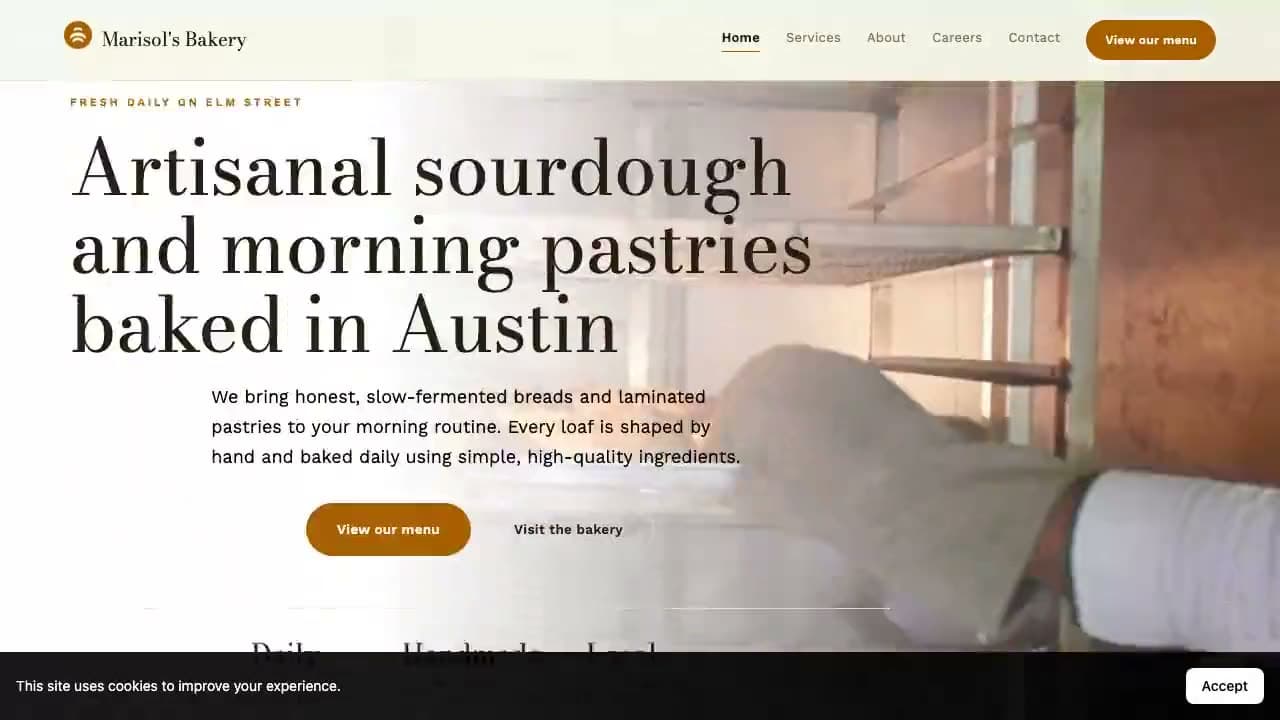
For a while, "AI website builder" meant one thing: a single scrolling page with a hero, a services block, and a contact form at the bottom. Fine for a quick pitch, but it never held up under real scrutiny. A prospect who actually knows web work would ask the obvious question: where's the page for each service? Where's the page for each location? A one-page site can't rank for "plumber in Round Rock" the way a real /locations/round-rock page can, and it can't rank for "water heater repair" the way a real /services/water-heater-repair page can.
That gap is closed now. bizvoid's Site Builder generates real, multi-page sites (every qualifying service and every qualifying location gets its own crawlable URL, not a scroll anchor) built on an actual design system instead of one generic template, with per-page SEO controls and a visual editor you can hand the client's browser to. The pitch changes from "here's a mockup" to "here's a live, indexable site, and I can change anything on it while we're talking."
Why one page was never enough
A single-page site is a landing page wearing a website's clothes. It's fine as a placeholder, but it has real costs the moment a client wants to be found:
- No page to rank for each service. Search engines reward a dedicated page that goes deep on "emergency plumbing" over a single paragraph buried in a scroll.
- No page to rank for each location. A business serving three towns needs three pages Google can actually index separately, not one page that mentions all three in passing.
- Nothing to hand a client and call "the site." Business owners expect a real Services page and a real Contact page they can send people to directly.
bizvoid's Site Builder solves this structurally: when a generated business has enough distinct services or locations to justify it, each one gets promoted to its own real route: a genuine page at a genuine URL, stored and served like any other page on the site, not a client-side scroll-to anchor.
A themed design system, not one template with the logo swapped
The other tell of a cheap AI-built site is that every business ends up looking the same: same font, same rounded cards, same layout, just a different name at the top. That's a hard sell to a prospect who's seen a hundred templated sites already.
bizvoid ships dozens of deterministic themes, each with its own type system, shape language, palette, and density, grouped by category (restaurants, beauty and hair, real estate, portfolios, ecommerce, and more) so the theme picker can suggest a register that actually fits the business instead of forcing one look on everyone. A salon and a plumbing contractor don't just get different colors; they get genuinely different visual systems. What you preview in the picker is the real site, not "a representative approximation" of what it might look like: there's no separate freeform pass that can quietly drift from the preview.
An SEO panel for every page, not just the homepage
Search visibility is exactly why per-page routing matters in the first place, so the builder treats SEO as a first-class editing surface, not an afterthought. Each generated page (the homepage, every service page, every location page) gets its own SEO panel where you can:
- Edit the page title and meta description directly, with live length warnings so you don't ship a truncated snippet
- See a content-depth verdict on the page so you know if it's thin enough to hurt rankings
- Review the page's head metadata as it will actually render
This is the difference between "we generated some pages" and "we generated pages you can actually get found through." You're not emailing a developer to change a meta description two weeks after handoff; you fix it in the panel while the client is still on the call.
A real visual editor, not a form full of text boxes
Once the site exists, bizvoid's Edit Mode lets you click into the actual rendered page and change it (text, images, layout blocks, effects) with an inspector panel for the selected element and an insert panel for adding new sections, all working against the real generated markup rather than a simplified preview. You can walk a client through their own site, click a headline they don't love, retype it, and show them the change instantly. That live-editing moment does more to close a deal than any slide deck.
What this changes about the pitch
The old pitch was: "I'll build you a site, give me a week." The new pitch is: "Here's your site: a real Home, Services, and Location page for every town you serve, already set up for search, and I can change anything on it right now." One of those is a promise. The other is proof, sitting in front of the prospect before the call ends.
What it costs
The Site Builder is available on every paid plan, metered by how many well-built sites you generate per month: 15 on Starter, 35 on Pro, and 75 on Agency, with stronger builds at each tier. The per-page routing, the theme system, the SEO panel, and the visual editor aren't a higher-tier unlock; they're what the builder produces at every plan level.
Ship the agent in the same sitting
The site you built already states the business's hours, address, services, prices and FAQ. bizvoid's Voice Agents, in beta, can put those facts to work on the phone. When you set up a receptionist, "Fill from your website" reads the Site Builder design and turns what the site says into the questions and answers the agent works from. Anything the site leaves out stays out, and the agent tells a caller it isn't sure instead of guessing.
The rest of the setup is short: a name, a tone, a greeting and a voice. The agent answers on a bizvoid number, and the owner keeps the number customers already know by forwarding it, either for the calls they miss or for every call. You leave the meeting with two things to bill, a one-time build and a monthly agent, and bizvoid's Client Billing (approval required) handles both.
The takeaway
Finding the lead used to be the hard part, and building the site was a separate project you scheduled for later, if the prospect was still around by then. That's no longer the bottleneck. You can generate a real, multi-page, SEO-ready site for a business the same day you find them, edit it live in front of the owner, and leave the meeting with a signed client instead of a follow-up task.